Health News
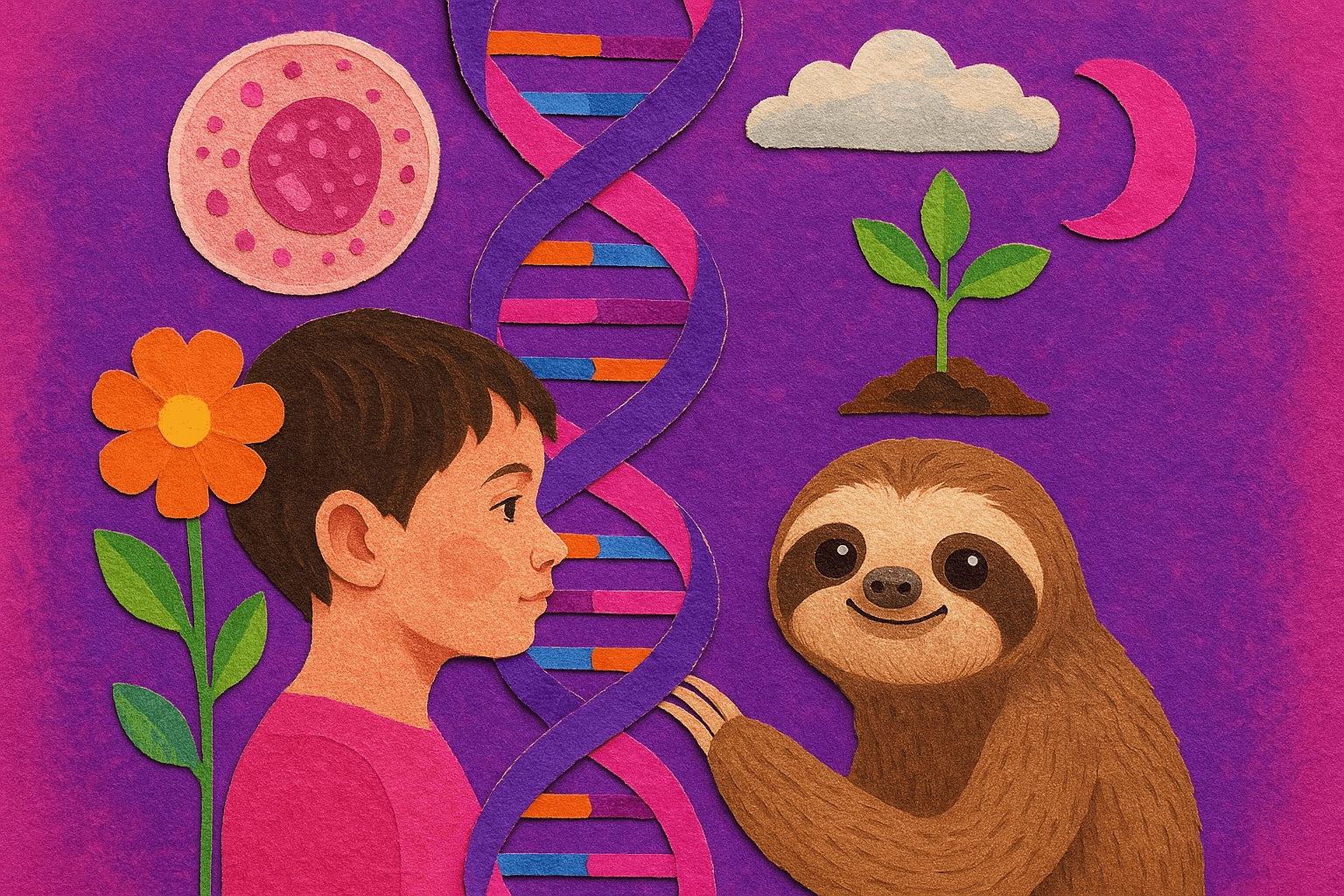
How our DNA changes as we grow
Discover how tiny changes in our DNA shape our growth and health, and how scientists use these clues to unlock new treatments for diseases like cancer.
Reviewed by Sofia Sigal-Passeck, Slothwise co-founder & National Science Foundation-backed researcher
Have you ever wondered how your body grows from just a single cell into the amazing person you are today? It is not just magic—it is science! At the heart of this process is DNA, which acts like a recipe book for building and running your body. But as your cells divide and multiply, little changes can happen in your DNA. These are called mutations, and while the word might sound scary, most of them are harmless. A recent article in the British Dental Journal shares the fascinating story of Dr. Manas Dave, a scientist who studies how these tiny DNA changes help us grow and sometimes even play a part in disease.
Understanding our DNA and cell family trees
When a baby is just starting to grow, it all begins with a single cell. As this cell splits to make more cells, each new cell copies the DNA from the original. Sometimes, tiny mistakes happen—like typos in a story. These are called somatic mutations. They are natural and happen to everyone. By carefully looking at where these small changes show up, scientists like Dr. Dave can trace how our cells are related to each other, almost like drawing a big family tree for every cell in the body.
Why these mutations matter for health
Most somatic mutations are harmless and just part of growing up. However, sometimes, certain changes can lead to problems, including diseases like cancer. By studying these patterns, Dr. Dave and his team at the University of Cambridge and the Wellcome Sanger Institute are learning how healthy cells develop and what goes wrong when disease strikes. They use advanced tools like whole genome sequencing, which reads every letter of your DNA, and mutational signature analysis to spot these tiny differences. This detective work helps doctors understand and treat diseases better.
How science and medicine work together
Dr. Dave is not just a scientist in a lab; he is also a doctor who helps patients in hospitals. His work shows how science and caring for people come together. He hopes his research will lead to precision medicine, where doctors can use a person’s unique DNA to give them the best treatment possible. If you want to learn more about how building strength as you age can help you stay healthier, check out this Slothwise article about muscle power and longevity.
The journey from discovery to patient care
Bringing discoveries from the laboratory to real-life patients takes a lot of teamwork and time. Dr. Dave works with other scientists, doctors, and even data experts to turn complex DNA information into something that helps people. He also works to make sure that new scientific findings are shared openly, so more doctors and researchers around the world can use them to help their patients. This open sharing is part of why journals like BDJ Open are important—they connect the global science community.
What it means for patients
All this research into somatic mutations and DNA is not just about science for science’s sake. It has real benefits for everyone. By understanding how and why cells change, doctors can spot diseases earlier, find better treatments, and even prevent some illnesses before they start. Young people are especially affected by changes in the world and their health, as explored in this Slothwise article about youth health challenges. New advances in genomics and health AI are making it possible for everyone, from kids to seniors, to get care that is tailored to their unique needs. As science keeps moving forward, the hope is that these discoveries will help us all lead healthier, happier lives.
Cool Health Tech
Apr 10, 2026
Buoy Health vs Slothwise: Which AI Health App Is Right for You?
Buoy Health was one of the original AI symptom checkers, born at Harvard and backed by Cigna, Humana, and Optum. It raised $87 million. Here is how it compares to Slothwise in 2026.
Cool Health Tech
Apr 10, 2026
Ada Health vs Slothwise: Which AI Health App Is Right for You?
Ada Health is the most accurate AI symptom checker, validated in a peer-reviewed BMJ Open study. Slothwise connects to your actual medical records and monitors your health continuously. They solve different problems.
Cool Health Tech
Apr 10, 2026
K Health vs Slothwise: Which AI Health App Is Right for You?
K Health raised over $400 million and shut down its consumer app in December 2025. Slothwise is independently built, listed on Medicare.gov, and still here. Here is how the two compare.